In 2008 the
entire business world was talking about how promising the emerging markets
were, some said that Brazil would become a major economical player within a
decade. Well, what happened with those fantastic predictions? The famous BRAZIL
COST happened! But what is exactly the Brazil Cost? In this article I will try
to explain in a way everyone can understand, eliminating all the technical and
economical terms suitable only for investment firms, what this burden really
is.
The BRAZIL
COST is pretty much what the title of this article says, it´s the cost of doing
business in Brazil, but what are these costs and how they impact trading in
Brazil? To facilitate the understanding I will divide this article in topics.
VOLUME OF GOVERNMENT
TAXAS
Brazilians
work 150 days to pay taxes according to IBPT (Brazilian Institute for Tax Planning). Yes, we Brazilians have to work five months out of a year just to
pay taxes. In the 80´s it was considerably less, 77 days in average. An astonishing
41.10% of all workers income goes to the government in form of taxes. For
business owners and executives the reality is equally brutal, payroll taxes
cost in average 58% of the salaries for example. The latest tax related absurd
that made the news was the Playstation 4 case. In Brazil Sony´s new gaming console
will cost R$3.999 (Brazilian reais) around U$1.845 (American dollars) with a
R$258 discount given by Sony. In the United States the same console costs
U$399, 4.62 times less that in Brazil. It´s cheaper for a Brazilian gamer to
hop in a plane to Miami, buy the console and come back home (U$899 airfare +
U$399 console = U$1.298). There are so many other ridiculous examples that
would turn this article into a book if we listed than all, so I will give you just
one more example, cars. The same Toyota Corolla cost in Brazil more than double
that it cost in the USA.

Now imagine
the kind of impact taxes have on company´s revenue and strategies, Sony´s image
was unquestionably harmed by this episode that truly had nothing to do with
their business practices but with the Brazil Cost.
COMPLEXITY
OF THE TAX SYSTEM
I challenge
any CEO of any multinational to send their most trustable accountant to Brazil
and without any help of a Brazilian tax specialist take over the operation. I
guarantee one of these two results: your company will go bankrupt or your
accountant will kill himself. The complexity of the tax system is not just
inefficient is design to trick business owner to play a nasty game of favor
trading and corruption. Some businesses wouldn´t survive if they pay all taxes,
so they crook their books. One day they will be caught by an inspector and will
have two options: pay a huge fine and face a lawsuit or pay the inspector a
monthly bribe for the rest of his life. Trust me there is no exaggeration in
what I´m saying, there are a total of 90 taxes (see the list)
divided in federal, state and city taxes, plus all sorts of fees and rules that
would drive any accountant mad. Just the current tax rules would produce a 112,000,000 pages book.
BUREAUCRACY
Everything
in Brazil is bureaucratic from starting up a company to getting married. There are
dozens of documents required, all of them have to be authenticated in a notary's
office. To import goods to Brazil you need a special license called RADAR, you need an uncountable amount of paper work and takes forever. While you can
nationalize imported goods in England in two days in Brazil takes in average
fifteen days and if your shipment gets red flagged just God knows when it will
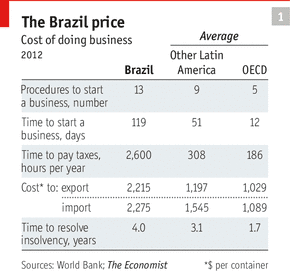
be released. Brazil is ranked 116ª in a list of 186 best countries to be an entrepreneur,
it takes 13 procedures and about 2.600 hours to start a business in Brazil while
in Singapore you need only 82 hours. The licensing process is cruel and it does
not distinguish between a high risk business like a Gas Station to a low risk
one like a Bakery Shop, the unfortunate baker would have to wait up to 180 days
to legally open the shop and having to support costs like rent in the meanwhile, it is a lot of pressure to a new business cash flow to endure and for this
reason many businesses are doomed from start or begin to operate without the appropriate
licenses.
INFRASTRUCTURE
According
to the study conducted by Mckinsey & Company
the lack of investments in infrastructure in the past 20 years caused a gap of
over 5 trillion reais, over 2.3 trillion dollars, to be resolved. While
China invested in the last 20 years 8.5% of its GDP per year, Brazil only
invested 2.2%. Brazilian ports quality are ranked 135º in a list of 144
according to the World Economic Forum, it costs in average twice as much to Brazilian companies to export than in other countries. There isn´t
enough storage space to keep our grain production so farmers have to leave it
in the open and try to sell it as fast as possible, even if the market isn´t
favorable. The United States have 224,792 km of railroads, Brazil has only 28,538
km connecting somewhere “far far away” to nowhere at all. For example the
North South Railroad, it´s been under construction for over 25 years and
already consumed over U$8 billion dollars is far from completed, from the total
of 4,576 km planned only a bit over 1,500 km is ready and the best part, is not
1,500 km of continuous tracks, it´s in bits and pieces connecting nothing to
nothing at all. The roads are pretty much what´s left, but they are not in great shape at all, even in major cities like Rio de Janeiro e São Paulo the conditions of the roads are precarious. We have a highway popularly known as the DEATH ROAD which registered close to 4,000 accidents with 155 deaths this year alone and this highway connects two major cities in Brazil, São Paulo and Curitiba. In the air the scenario isn´t much better, Brazil have a great amount of problems with its airports, mainly because there isn´t enough airports or flights or airliners to supply the market and the result is chaos.
 |
| North South Railroad - only the green part is ready |
The Brazilian government took over 20 years to acknowledge the fact that
the only way to improve the country´s infrastructure and therefore its
competitiveness in the global market was to open the transportation sector to
private investors and began the biggest privatization and concession of roads,
ports and airports in Brazil´s history. The expectation for the near future is
to double the amount of ports and flights, but other problems might linger for
years to come like railroad construction and grain storage for example.
CORRUPTION
Corruption
is present in every public organization in Brazil, from the
Ministry of Transports to the public health care center next to your home. Corruption
is so present in the Brazilian people´s lives that we get surprised when a
Police Officer of any branch doesn´t accept a bribe. Multinationals like Siemens and Alston are currently under
investigation for their involvement in a bidding cartel case related to the São
Paulo Subway System estimated in over 1 billion Brazilian reais. I very much doubt
these companies would offer bribes to city officials in their HQ countries (Germany and France), they know better, but in Brazil why not? After
all it´s how things work around here. The most famous corruption case the
voting-buying case known as “Mensalão” was just closed and the claimed leader
of this Mob (I don´t know a better word to describe them), Jose Dirceu, a
former Minister of President Lula, was sentenced to 7 years and 11 months in a
semi-open regime, where the convict can work during the day and sleep in prison, but after one third of his sentence he would go to a open regime,
pretty much like freedom. Now I ask you if someone offered you U$20,000,000
dollars just to sleep in a prison for 2 years, would you take it? Presuming the
money wasn´t originated from corruption, let´s say a Sheik was bored and wanted
to see if you would do it, would you? This was the first case related to corruption involving important politicians in the government hierarchy that
resulted in jail time, most cases result in nothing. Former President Collor faced an impeachment process, resigned and was considered unelectable for 8 years as the result of a corruption scandal during his presidency is now a Senator and, believe it, is in charge of the federal budget.
I guess by now
you have a sense how corruption affects businesses in Brazil, beginning with an
ethical perspective, if you are a 100% honest executive would you manage a
company involved in government bidding? If you don´t play the game you are out, if
you play, God knows what´s going to happen, probably nothing, but would you be
able to sleep at night? Could you face your God on Sunday´s church mass?
VIOLENCE
After “Carnaval”
and “Caipirinhas”, violence is probably the most well known feature about
Brazil, but focusing only in a business point of view, how violence impacts a company´s business strategies? Finding a secure warehouse is the first challenge,
there are warehouses “condos” that offer private security, but costs a lot more
than a “street” warehouse. If you decide to rent or buy a warehouse on the
street, you most likely will have to hire a security guard team, install
cameras and alarms and pay a stiff insurance premium. On the transportation
side the carrier charges you an insurance fee on top of your invoice, let´s say
your load is worth U$100,000 you would pay around U$1,500 of insurance plus the
transportation fee of course. If your load is worth more than R$500,000 (Brazilian
reais) you would need to hire an armed escort service otherwise the insurance
won´t accept your claim.
QUALIFIED
LABOR
In Brazil
exists a phenomenon that I´ve never seen anywhere else in the world, we have
great public universities and awful public elementary and high schools, as a consequence
of this phenomenon until a few years ago pretty much only students from wealth families
which had the opportunity to study in private schools were able to get into a
public university because the admission test was too hard for the public school
curriculum. Students from low-mid class families, forced to study in
public schools all their lives, couldn´t continue their studies because they
couldn´t get into a public university and the result of this distorted educational
system is non-qualified labor. Hundreds of second class private universities
popped up all over the country trying to bite a piece of this incredibly large market
of students boot out of the good universities, so now pretty much everyone have
an university degree but not a lot of qualification.
Today there
are a reserved amount of vacancies for students originated from public schools
in all public universities in Brazil, an attempted to include students from all
social classes into the public universities system. Other government programs
give grants to public schools students to study in private universities and dozens
of technical training programs were developed to qualify workers around the
country, but there is still a large gap to fulfill.
INTEREST
RATES
Brazil has
the HIGHEST interest rate of the world according to the research conducted by
the website Moneyou,
3.40% per year after deducting the inflation rate. To compare, Mexico has 0.30%
real interest rates. The SELIC, basic reference government interest rate, is
9.5% per year today, that’s the rate banks borrow money, on top of that they
add the bank spread, which is their profit plus the default. The credit card
interest rate today is 11.90% a MONTH! Want to buy a car? The interest rate for
this operation is 3.1% a month in average, in the end of 36 months you´ve paid more than 2 cars. For companies the
scenario isn´t much brighter either, short term loans have in average a 2.2%
rate per month. There are government banks like BNDS that offer much better
rates, but is away more bureaucratic too, making credit taking not only risky
but labor intensive as well.
Everything
I said in this article is based on facts easily verifiable on the Internet (I´ve
included some links as well), but this article instates not only the facts but
my opinion too. Some might say that things are not so bad, that Brazil is a
great place to do business, I think you should make your own opinion, do some
research, ask other people, come visit, do whatever suits you, just don´t buy
that same old crap where Brazil is the country of the future because it isn´t!
 Don´t get
me wrong I love my country, if someone tries to invade Brazil I would fight for
it, but doing business and living in this country is not an easy task, I know
there is someone from Iraq saying: “You don´t know what’s bad, we are at war!”
Don´t get
me wrong I love my country, if someone tries to invade Brazil I would fight for
it, but doing business and living in this country is not an easy task, I know
there is someone from Iraq saying: “You don´t know what’s bad, we are at war!”
It´s true, but I live in a country where more people are murdered every year than
Iraq in war, don´t just believe me, go ahead and check. Of course there are honest cops, public servants, even politicians, but they are a minority, actually the honest ones are used as an alibi by the corrupted ones to justify the existence of the entity they work at.
I honestly hope my
country progresses to a better future, I´m also European (Portuguese)
and I´ve lost count of the times I said: “I´m leaving this country forever!” but
here is another quality about Brazilians, besides beauty (don´t hate me because is the
true), we have this incredible ability to believe that the best is still to
come and hopefully our politicians won´t prove us wrong.
.jpg) Currently living the worst political and economical crisis after its redemocratization, Argentina of Cristina Kirchner
has been imposing trade barriers to Brazilian products for years. After
her reelection President Kirchner announced that she will continue to impose TRADE BARRIERS to imported goods, including those from Mercosur
member states, until the end
of her presidency and that Argentine businessmen will have until 2015 to become more competitive.
I can understand that the Argentine government
is trying to protect its market,
nothing wrong with that, but what I can not understand is why the Brazilian government accepts to stay in this so called common
market!
Currently living the worst political and economical crisis after its redemocratization, Argentina of Cristina Kirchner
has been imposing trade barriers to Brazilian products for years. After
her reelection President Kirchner announced that she will continue to impose TRADE BARRIERS to imported goods, including those from Mercosur
member states, until the end
of her presidency and that Argentine businessmen will have until 2015 to become more competitive.
I can understand that the Argentine government
is trying to protect its market,
nothing wrong with that, but what I can not understand is why the Brazilian government accepts to stay in this so called common
market!
 So what is the
solution? Well,
I'm no expert, but the solution seems pretty obvious. Force Mercosur´s Council
to allow its member states to negotiate directly with countries outside the common
market threatening to leave Mercosur which would essentially cease to exist
without Brazil. After all we
have the seventh largest nominal GDP in the world and it's time we use our strength
to get what is best for Brazil.
So what is the
solution? Well,
I'm no expert, but the solution seems pretty obvious. Force Mercosur´s Council
to allow its member states to negotiate directly with countries outside the common
market threatening to leave Mercosur which would essentially cease to exist
without Brazil. After all we
have the seventh largest nominal GDP in the world and it's time we use our strength
to get what is best for Brazil. 